


 Email this article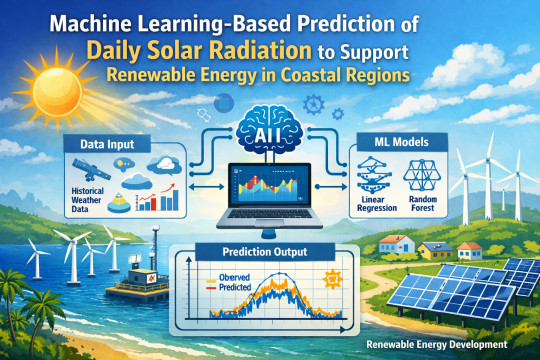
Machine Learning–Based Prediction of Daily Solar Radiation to Support Renewable Energy Development in Coastal Regions
Abstract
Reliable estimation of surface solar radiation is essential for climate analysis and solar energy planning, particularly in data-limited regions such as coastal Africa. This study investigates the long-term variability of surface solar radiation and evaluates the performance of machine learning models for its prediction using a comprehensive reanalysis dataset spanning 1940–2024. Five radiation components—net surface solar radiation (SSR), clear-sky net radiation (SSRC), downward surface solar radiation (SSRD), clear-sky downward radiation (SSRDC), and total surface radiation (TSR)—were analyzed to quantify the influence of atmospheric attenuation caused by clouds, aerosols, and water vapor. Five machine learning algorithms—Linear Regression (LR), Gradient Boosting (GB), Random Forest (RF), k-Nearest Neighbours (KNN), and Artificial Neural Network (ANN)—were implemented and evaluated using train–test split, k-fold cross-validation, and leave-one-out validation. The results reveal strong interannual and multi-decadal variability in solar radiation, with clear-sky radiation consistently exceeding all-sky radiation, confirming the dominant role of atmospheric modulation in the region. Among the tested models, Linear Regression achieved near-perfect predictive performance (R²≈ 1.0) with the lowest error statistics, indicating that surface solar radiation over coastal Africa is largely governed by linear radiative processes. Gradient Boosting and Random Forest also demonstrated high accuracy (R² > 0.98), while the Artificial Neural Network showed poor generalization due to overfitting. The findings demonstrate that computationally efficient and physically interpretable machine learning models can reliably estimate long-term solar radiation in coastal Africa. This provides a robust scientific basis for solar resource assessment, photovoltaic system design, and climate-resilient renewable energy planning across the region.
Citation: Umoh, M., Evans, U., Akpan, S., Otene, S., & Olanrewaju, A. (2026). Machine Learning–Based Prediction of Daily Solar Radiation to Support Renewable Energy Development in Coastal Regions. Trends in Renewable Energy, 12(1), 20-32. doi:http://dx.doi.org/10.17737/tre.2026.12.1.00198
Keywords
Full Text:
FULL TEXT (PDF)References
Tajjour, S., Chandel, S. S., Alotaibi, M. A., Malik, H., Márquez, F. P. G., & Afthanorhan, A. (2023). Short-Term Solar Irradiance Forecasting Using Deep Learning Techniques: A Comprehensive Case Study. IEEE Access, 11, 119851-119861. doi:https://doi.org/10.1109/ACCESS.2023.3325292
Hissou, H., Benkirane, S., Guezzaz, A., Azrour, M., & Beni-Hssane, A. (2023). A Novel Machine Learning Approach for Solar Radiation Estimation. Sustainability, 15(13), 10609. doi:https://doi.org/10.3390/su151310609
Benatiallah, D., Zahouani, A., Yahiaoui, A., Djeldjli, H., Nasri, B., Benatiallah, A., & Benabdelkrim, B. (2024). Estimating of Solar Radiation Based on Machine Learning Approaches under Algerian Desert Climate. Instrumentation Mesure Métrologie, 23(5), 363-374. doi:https://doi.org/10.18280/i2m.230504
Sinha, N., Kulkarni, R., Thakkar, P., & Shiragapur, B. (2023). DEEP LEARNING BASED MODEL FOR PREDICTION OF INCOMING SOLAR RADIATION. Journal of Engineering Technologies and Innovative Research, 10(5), 285-289.
Senekane, M., & Taele, B. M. (2016). Prediction of solar irradiation using quantum support vector machine learning algorithm. Smart Grid and Renewable Energy, 7(12), 293-301. doi:http://dx.doi.org/10.4236/sgre.2016.712022
Abdelhag, M. E., Elmarud Ali, S. E., Amin, S. T., Khan, A. A., & Metwally, A. A. (2022). Machine Learning Based Model For Solar Radiation Prediction. Advanced Engineering Science, 54(2), 2583–2591.
Tandon, A., Awasthi, A., Pattnayak, K. C., Tandon, A., Choudhury, T., & Kotecha, K. (2025). Machine learning-driven solar irradiance prediction: advancing renewable energy in Rajasthan. Discover Applied Sciences, 7(2), 107. doi:https://doi.org/10.1007/s42452-025-06490-8
Suyono, H., Santoso, H., Hasanah, R. N., Wibawa, U., & Musirin, I. (2018). Prediction of solar radiation intensity using extreme learning machine. Indonesian Journal of Electrical Engineering and Computer Science, 12(2), 691-698. doi:http://doi.org/10.11591/ijeecs.v12.i2.pp691-698
Rahman, S., Rahman, S., & Bahalul Haque, A. K. M. (2021). Prediction of Solar Radiation Using Artificial Neural Network. Journal of Physics: Conference Series, 1767(1), 012041. doi:https://doi.org/10.1088/1742-6596/1767/1/012041
Ayyoubzadeh, S. M., Ayyoubzadeh, S. M., Zahedi, H., Ahmadi, M., & R Niakan Kalhori, S. (2020). Predicting COVID-19 Incidence Through Analysis of Google Trends Data in Iran: Data Mining and Deep Learning Pilot Study. JMIR Public Health and Surveillance, 6(2), e18828. doi:https://doi.org/10.2196/18828
Okafor, I. R., Stephen, E., Chen, G., Jones, G., Onyema, O., & Ezekiel, A. (2024). Prediction Of Daily Solar Radiation In Southeastern Nigeria Using Extreme Gradient Boosting Model. World Journal of Engineering Research and Technology, 10(10), 61-108.
Ramli, N. A., Hamid, M. F. A., Azhan, N. H., & Ishak, M. A. A.-S. (2019). Solar power generation prediction by using k-nearest neighbor method. AIP Conference Proceedings, 2129(1), 020116. doi:https://doi.org/10.1063/1.5118124
Rafi, M. A. I., & Sohan, M. R. (2024). Enhanced Solar Radiation Prediction with Machine Learning: A Comprehensive Analysis of Meteorological Data Using Random Forest. Paper presented at the 2024 15th International Conference on Computing Communication and Networking Technologies (ICCCNT).
DOI: http://dx.doi.org/10.17737/tre.2026.12.1.00198
Refbacks
- There are currently no refbacks.
Copyright (c) 2026 Mfon D. Umoh, Udoh F. Evans, Sunday A. Akpan, Sunday E. Otene, Akinola B. Olanrewaju

This work is licensed under a Creative Commons Attribution 4.0 International License.
 This work is licensed under a Creative Commons Attribution 4.0 License.
Copyright @2014-2026 Trends in Renewable Energy (ISSN: 2376-2136, online ISSN: 2376-2144)